First of all, random fun fact, that will also give you a privy behind-the- scenes-glimpse about the nifty way of how I get ideas for blogposts: If you do a google image search on the history of pants a picture of Marlene will show up.
The mere fact that Marlene was wearing pants was a rebellious act. The quick history about pants is that Women did not wear them. Point blank. I could actually end this post right here. If you think this sounds rather antiquated, think again!
Do we have some Vintage TV show lovers who still remember the British TV-Show The Avengers? Starring actress Diana Rigg who in her role as Emma Peel immortalized slinky leather catsuits, PVC jumpsuits and low-rise hipster trousers? Emma Peel “kung fu kicked down television’s puritanical costume regulations to created a character who came to define the look of the swinging 60s” [1] Yeah this powerhouse of a woman was refused at the door of a nightclub in NYC in the 60s. For what you might ask? Wearing a pantsuit!
Romy Haag: Queen of the club, queen in pants.
Think that is due to the square Americans? Think again! In Romy Haag´s biography, Berlin´s most interesting transwoman (IMHO) recounts a scene where she was refused entry at a London nightclub in the 70s. The reason? Pantswearing! Not only that, but this daring Dutchie who eloped to Paris via Hamburg as a 15-year-old kid to dance in a club also writes about her fake ID and the Paris demimonde she was pushed into since wearing women´s apparel as a “men” was forbidden in France so getting a job that includes daylight was out. Although those of us who have seen the Netflix show Pose know that getting a job that does not involve prostitution or showbusiness as transwomen was difficult well into the 90s. This sounds somewhat counterintuitive since Paris had a thriving glamourous cabaret scene in which transwomen played a major role, which Berlin, although a lot more liberal when it comes to transsexuality, had not. Not only that but a lot of transwomen in France had gotten gender reassignment surgery in Algeria. On top of that she recounts that you could get synthetic estrogen in France long before anywhere else. This was due to a Jew who survived the Holocaust. The Nazis had experimented on him with synthetic estrogen in order to humiliate him. Well into the 70s the now breasted man ran a business out of his Paris apartment that catered to transwomen. And yes the irony should not get lost here, that it was the Nazis who helped transwomen grow breasts! Fun fact: In the 70s Marlene Dietrich had somewhat of a cult following in Paris, especially in the transcommunity. A lot of them met up to press their ear against the other side of the wall of Dietrich´s Paris apartment. And one time Romy recounts that she paid homage to Marlene styling herself as our girl and developing a Marlene dance routine when she heard that Mrs. Dietrich would visit one evening. What do you think was Marlene´s reaction? She walked straight out. Marlene Dietrich when it came to fashion and her image was dead-serious to the point of not understanding veneration, humour, homages.
Pants: a hasty history from Joan of Arc to Marlene
Ok but starting from the beginning! in ancient Rome, togas were worn by men and women alike although later on they were forbidden for women with the exception of high class prostitutes and divorced women for adultery (They were probably even forced to wear them but well…Just don´t ask!) Anyway skirts seem comfortable and its a good idea to air out fuck parts once in a while especially if you are prone to STD´s and weird rashes. (I was told so! Why u askin?!) But since I wanna talk about pants I am going to fast forward a bit and talk about the the first famous female wearer of pants, which was probably Joan of Arc. “Joan of Arc famously cross-dressed, wearing men’s armor in the 15th century as a deterrent to rape (and was eventually burned at the stake in part because of this)”.[2]
For a long time then there was nothing apart from the regular freak who´d dared stopping the stream of sacred female energy flowing in between their legs. If you are wondering what I am babbling about, I once had to listen to a Russian naturopath telling me that all of my menstrual issues stemmed from the fact that I was wearing pants which had completely stopped the scared energy which needs to flow from the earth into my papaya and from there on scream into the world that it’s party time and we are open for business shine my stellar female light into the world.
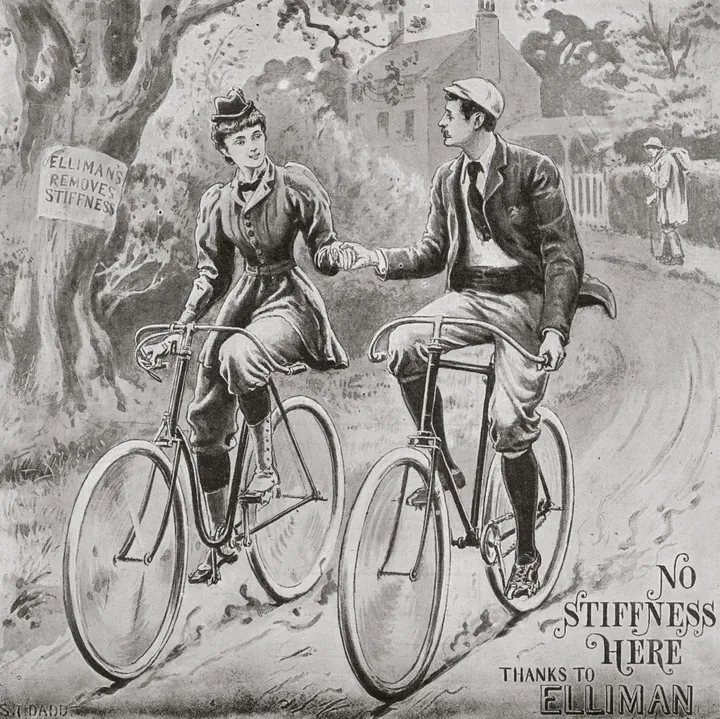
But now the loophole that George Sand the famous French writer and a few other intellectual women in both America and Europe had carved out for themselves by wearing pants in the 19th century became bigger and bigger. They were permitted for certain exercises such as cycling! You could wear them for gardening activities!
And then there was world war I and in Berlin a lot of women took men jobs such as delivering mail or started working in factories, so fashion became a bit more practical, but it was seen as an exceptional thing because wartime. D`uh. However pants or suits were basically a must in Berlin´s lesbian bars who started to appear exponentially in World War 1 when a lot of husbands did not return home. By now you must probably understand the earthshattering symbolical meaning pants had. Marlene grew up in a place that was probably the first LGBTQ hotspot there ever was, where an openly gay suit-wearing Claire Waldorff, the women that some call the Marlene of the people before there was a Marlene, was celebrated and loved by probably the entire city of Berlin. But here is the thing, 20s Berlin and its ubiquitous lesbian bars, was a microcosm that collided with the fashion code of most of the world. Marlene´s older sister completely identified with the even tinier microcosm of her mother and her mother´s side of the family and the “Prussian” or “imperial” or “protestant” values or wherever you want to locate the repressive and austere upbringing, Marlene and her sister were subjected to, that included odd orders such as eating lunch in total silence in order not to disturb digestion. Moral of the story? Choose it wisely, that microcosm! One might get you to defy fascism, become the highest paid actress of your time, the most desirable woman of your time, have pants named after you and the other will make you a fascist teacher/housewife whose existence will be denied in interviews because who would want to be associated with that?
But back to pants! Gabrielle “Coco” Chanel who had opened her first shop in Deauville in 1913 and successfully banned the over dimensional hats of the Belle Époque and offered simple costumes made out of Jersey that was previously only used for gentleman´s apparel. Say what you want about Coco “Nazyspy” Chanel but in terms of fashion she was trailblazer, ahead of her time. After the war she launched the beach-pajama with flowy white legged pants which was a scandal AGAIN because the war was over, and women were supposed to be ushered back into their dresses, but the female collective consciousness wondered whether there is more to being a woman than looking like a public restroom icon and from then: on women claimed and conquered pants and no one could stop them. Fun fact: the law of prohibiting pants for women in France was only abolished in 2013.[3]
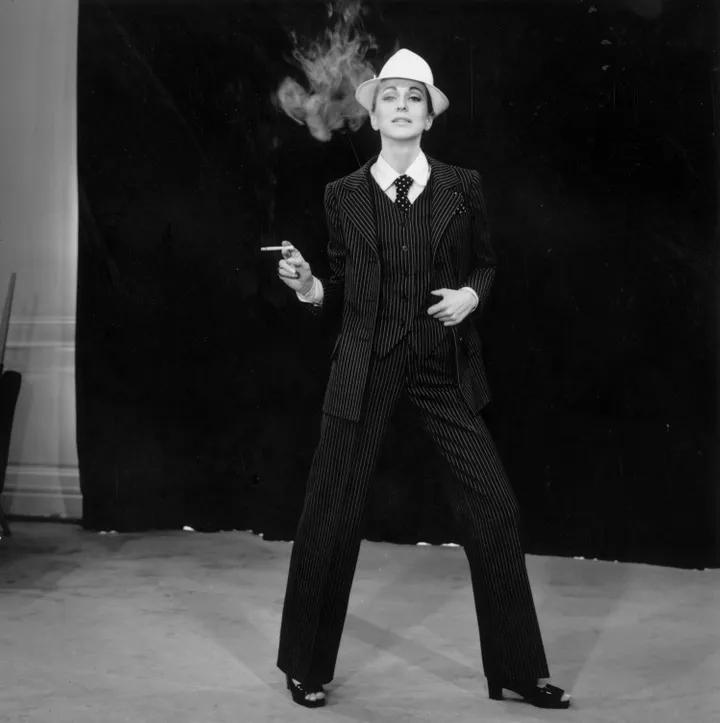
Anyway Hermès probably thought of them as crazy revolutional when they became the first fashion house to come up with a pair of pants for women in the 1930s. Yawn! Late to the party Hermès! When your local garden center is more advanced in fashion, that should give you something to think about but in order to understand this trope you have to read the end of this article. But hey Yves Saint Laurent probably thought they were groundbreaking renegades when they became the first fashion couturier who came up with a suit for women. Snoozefest-socialites subsequently pretended they were subversive sirens when they sashayed around in suits, but I am having a hard time to believe that anyone was dazzled or even impressed. Nevertheless I still want to mention a few unforgettable fashion moments. Namely Bianca Jagger´s seminal Yves Saint Laurent Wedding suit. (scroll a bit down for the best pics )And then Helmut Newton shooting a dimly lit Parision street starring a smoking model with slicked-back hair. (again scroll down for the full pic, I unfortuntaely do not have the rights to any of those iconic pictures. 🙁 )
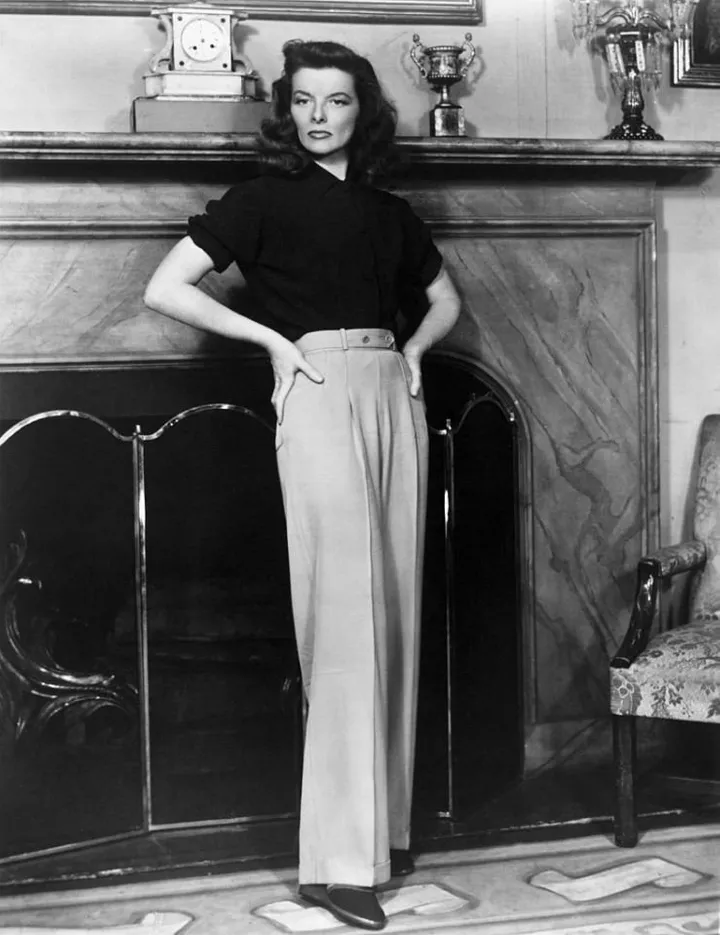
Last not least Annie Hall. I know I know, Woody Allen has been rightfully canceled a long time ago, but no talk about the history of pants would be complete with the famous pantswearer Diane “Annie Hall” Keaton. “In her 2011 memoir, Then Again, Diane Keaton writes that Woody Allen told her to “wear what you want to wear … move around like a real person” when he directed her in Annie Hall. What she wanted to wear was “what the cool-looking women on the streets of SoHo were wearing … Annie’s khaki pants, vest and tie came from them.” Ralph Lauren provided most of the clothes, but the styling concept came from Keaton’s fascination with downtown urban style.”[5]
Marlene does pants
On the night of the premiere of the blue angel in Berlin, Marlene boards a ship to America. Joseph von Sternberg her discoverer had helped her to get a good contract with Paramount. Back in the day actors and actresses were hired by the studios and sometimes those contracts were bonafide adhesion contracts where the studio could make you take terrible roles (and mingle in your private affairs as you learned in part 1 of this series) if they did not like you. But none of that for Marlene, she got a fine deal. Marlene obviously arrived in pants, provoked a small scandal, and was directed into a dress.
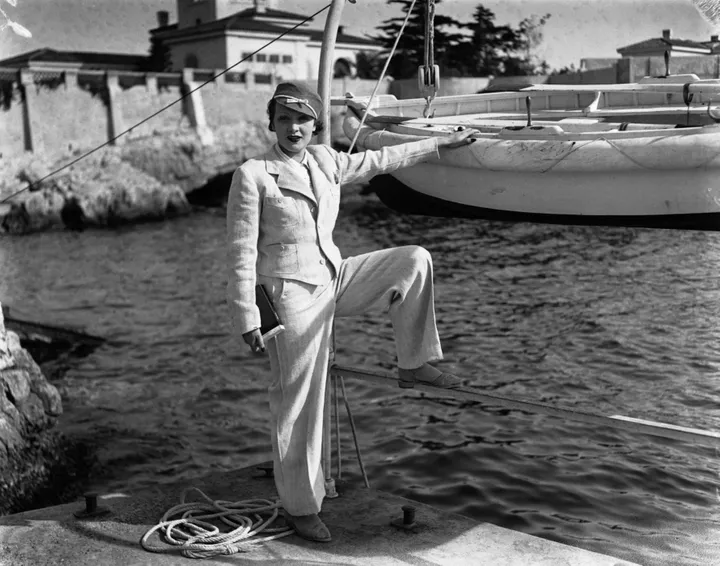
In Los Angeles Blake McVeigh, Paramount´s PR man calls her to schedule a photo shooting and the conversation naturally moves to apparel. He obviously tells her that she can´t wear pants but this time she had enough so she rolls her eyes and basically tells him “No pants no pictures” so McVeigh has no other possibility than have the pictures taken with the blonde bombshell in a marine blazer, a sailing hat and white flannel pants that would make Jean Paul Gaultier proud. Mc Veigh is ready for both a media scandal and a whipping from his boss. The pictures are released and soon all gardening pants for women are sold out. The magic of Marlene.
She basically repeated the same thing in France when she arrived there equipped with her crotchfruit Maria and “luggage containing twenty-five suits of male clothes, dozen´s of men´s shirts, neckties and socks she boarded the “Europa” in New York and arrived in Paris on May 19. Within hours the Parisian newspapers were detailing her shocking outfit: a chocolate-colored Polo-coat, a pearl grey suit, white shirt and tie and aviator´s goggles perched saucily atop a felt hat. One Parisian magistrate suggested the next day that she be threatened with arrest for impersonating a man, and in fact the police seriously considered a warrant. This idea collapsed when Maurice Chevalier told a journalist that Dietrich was a friend to all Frenchmen who loved freedom.”[4]
Sources
Brucculieri, Julia (2019) Women and pants: a timeline of fashion liberation. Huffington Post. https://www.huffpost.com/entry/women-and-pants-fashion-liberation_l_5c7ec7f7e4b0e62f69e729ec . Accessed January 29, 2023
Haag, Romy (1999) Eine Frau und mehr. Ullstein Buchverlage GmBh & Co, Berlin
[1]Elan, Priya (2020) . Dressed to kill: How Diana Rigg became a 60s style icon https://www.theguardian.com/fashion/2020/sep/11/diana-rigg-emma-peel-the-avengers-swinging-sixties-style-icon-fashion. The Guardian. Accessed January 17, 2023
[2;3]Mondalek, Alexandra (2018) The history of women wearing pants as a power symbol. Huffington Post. https://www.huffpost.com/entry/the-history-of-women-wearing-pants-as-power-symbol_n_5a99bb95e4b0a0ba4ad34fe7 Accessed January 23, 2023
[5]Morley, Jess-Cartner (2021) How Annie halls dad pants conquered the world https://www.theguardian.com/fashion/2021/jun/15/great-strides-how-annie-halls-dad-pants-conquered-the-world accessed on January 21, 2023
[4] Spoto, Donald (1992) The life of Marlene Dietrich, Cooper Square press, New York, NewYork
Wieland, Karin (2015) Hollywood, Berlin: A century in two lives. Liveright. New York, New York. kindle edition.
Lots of super interesting facts that I wasn’t aware of!! Exciting read <3