I never intended to work in political education. I actually try to avoid reading too much politics because it simply depresses me. In my guided tours I talk about fine arts, architecture, art history, movies, music, fashion, interesting people in the arts- the finer things in life. But even an ignorant escapist like me runs into problems at some point. You can´t talk about German expressionism without world war 2. You can´t talk about German romanticist literature without talking about the 7 year war, you can´t talk about the golden age of German cinema in the 20s without talking about its downfall that is intertwined with the mass exodus of Jewish filmakers and writers. I mean, hell I can´t even talk about an
old Hollywood goddess like Marlene and focus on such a vapid thing as fashion without talking about World War 1 without which women would not have started to wear pants.

Every excuse for a Marlene pic right?
My first tours were in the Prussian palaces and while I loved walking through lavish luxury talking about the difference between baroque style of interior design vs Rococco. I`d go into endless autistic rambles about French silk production, fine Chinese porcelain, Ming vases but at some point if I would have forgone the history of Prussia completly, I would have been fired with the recommendation to open up a concept store or try my luck at hosting a teleshop. Trust me I did enough sessions of Internal family systems to identify that I have an inner “Let`em eat cake”–princess that would top aristocrats in the out of touch-Olympics and could talk about hours about trophy wife occupations. My autism spectrum disorder does not help much. Neither does the fact that I am the crotchfruit of a single immigrant mother whose monthly income falls under the poverty line in Germany.
But yeah, earlier this year I started giving tours at the holocaust memorial which entailed researching a lot more about this topic. And I found an intersection that connects my in-depth exploration into the Nazi regime and world war 2 with my main interests which is artsy fartsy ADHD-powered pseudo deep dives. Because d´uh. Auschwitz is kinda depressing. If I wanna write about a gory mess I am going to write a biography. Ok all joking aside. I mean, my life choices remain questionable, but art reflects society on levels that history can´t. Mainly because art never claims factual truth like history does. As a former student of literature, I feel compelled to allude to the argument between Plato and Aristotle, that is Plato denigrating literature as a lie because it represents appearance rather than truth and Aristotle conceding that literature is actually superior to history because it deals with fundamental truth rather than that of particular characters and events.[1] Kyria Sobrinhos opinion is that you can substitute art with literature and then in 2023 I am not sure how many times I heard the quote that history is written by the winners and even French schoolbooks finally stopped depicting their nation as heroic due to colonization but rather barbaric. For some reason the older I am getting the more I am interested in history and the less I am interested in literature. I grew up to be more rational with the years and now enjoy looking at art at in its historical context.
The power of images: Jews.
I think a minority of people are aware about the actual power of images. I wrote about this abundantly in my first article on this blog when I linked hyperrealities with the world of Rap. I know it’s a hot topic, but it has been a hot topic for a longer while than you think, I think. So I grew up in Germany, a country whose claim to fame is having killed 6 million Jews.
This is a fact. But where the history gets distorted is that 36% of all Germans think that their ancestors were rather victims of the Nazi regime, 32% of all Germans think that their ancestors rescued and helped Jews. In reality it was 0,3% though. That is a 300% increase.
This is obviously mostly due to the mental gymnastics us humans have in our heads so that we are always “the good” but also due to literature, movies, stuff your granny tells you, short things that are not based in reality. Needless to say, there are always two, if not more sides to a story but you know with World War 2 stuff the “I just followed orders” has been heard one times to many. When I was a kid, Schindler´s list was the movie to watch. Even my teachers recommended it. The movie shows the good German risking their life to save Jews. Steven Spielberg´s basically tells a story of 300 rescued Jews. But that is not the story of what happened during the Nazi regime. During the Nazi regime, 6 million Jews were killed. I mean d´uh. Hollywood. But even before Schindler´s list, in 1959, there was the movie version of “the diary of Anne Frank” where Audrey Hepburn was supposed to play Anne Frank and would have been Anne Frank´s father first choice but she ultimately declined. Otto Frank himself was at least played by an Austrian American Jew but otherwise the cast remained questionable. Times where different and while slapping skin-darkening make-up and a prosthetic nose on mixed-race bombshell Zoe Daldana as Nina simone in the synonymous 2016 biopic provoked a small scandal, there was not much awareness of racial sensitivity when it comes to casting back in the day.
Holocaust-Simulacra
Then in 1961 Marlene Dietrich and Judy Garland starred in “Judgement at Nuremberg”. The most controversial was probably NBC´s 1978 mini series “Holocaust” starring Meryl Streep because OF COURSE, I mean where is Meryl Streep not and of course she got her awards and yada yada yada.
Everything I read about this series is that it was shit and historically very inaccurate. Guess who made the term “holocaust” popular though? This show. What remains a question is the fact that, would the producer have named it “Shoah” would that term be more in use? What if they would have called it “Meryl´s finest”?
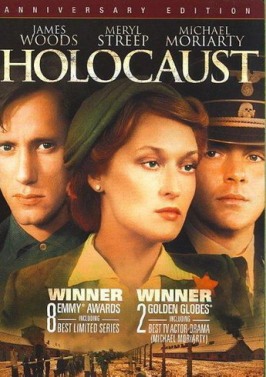
Btw should I mention the random act that I corrected my own typo of writing “Hollywood” instead of “holocaust” twice? Oh irony, even in my subconscious I can never get enough of you!
Here is the thing. We live in a picture-universe. If you want to learn anything by heart, study coaches recommend to tie it in into a visual. Our brains apparently crave that. And apparently they take whatever. Before the mentioned movies and shows another Image tradition existed though.
Image traditions: Peyo
You probably heard about antisemitic imagery in popular kids cartoons such as pretty much everything by Disney before they suddenly became woke, or Peyo´s smurfs. You know Gargamel the evil hooked nose baddie, perennially trying to catch the smurfs. Then Gargamel and Azrael (his cat) are typically Jewish names. Antoine Bueno, a lecturer at Sciences Po in Paris claims Peyo the smurf creator was probably not antisemitic but drew from a canon of antisemitic imagery. Aka the Image tradition was so strong that he, who (allegedly) did not have any antisemitic tendencies, was compelled to create the smurfs like that, as it is (allegedly) impossible or at least extremly hard to emancipate oneself from such image traditions.

The high-class, high-maintenance, high-brow Appreciater of art might feel the need to point out that “Well of course a smallminded Cartoonist might not be able to emancipate himself from a barbaric image tradition. This would never happen in the sort of media products that I invest my time in. If I would ever engage in the 7th artform as me the high-priestess of culture call cinema its French nouvelle vague, Italian neorealism… German expressionists, otherwise I spend my free time reading the structuralists, Foucault, Derrida and for a lighter read I like to hunker down and dive into Lacanian psychoanalysis because OF COURSE” Ok well let´s talk German expressionists then, lets talk FW Murnau! Or better: antisemitic images in Murnau´s Nosferatu, And yes you will also find out what I mean by G-words so stay tuned!

Murnau by Leo Kober (1876-1931) I picked this due to the sharp expessionist lines that came to define the stylized films of German expressionism
[1] Aristotle 29-31
{2] Flood, Alison. (2011) Smurfs accused of antisemitism and racism. The Guardian https://www.theguardian.com/books/2011/jun/06/smurfs-accused-antisemitism-racism
What a thought-provoking article!
Walkyria’s exploration of the intricate relationship between political history and artistic passion in “Hyperrealities Reloaded: Jews and G-words” is truly compelling. The seamless journey through Prussian palaces to Holocaust memorials vividly illustrates the inseparable link between art and history. The focus on the power of images, whether in acclaimed films like “Schindler’s List” or controversial cartoons like Peyo’s Smurfs, adds a layer of complexity to the discussion.
Walkyria’s examination of antisemitic imagery in popular culture raises important questions about our ability to break free from ingrained image traditions. It’s a call to reflect on the profound impact of visual narratives on collective memory and challenges the assumption that certain cultural spheres are immune to perpetuating harmful stereotypes. This article invites readers to engage in a deeper exploration of how art shapes our understanding of history and encourages us to critically examine the images that become ingrained in our cultural consciousness.
I can’t wait to find out what you mean by G words. Bring it up.
Ahh! Thank you so much for this comment!
What you said about the movie Holocaust making the word common use – I didn’t now! So interesting, and worrying, the power of Hollywood.
Also, did not know this about The Smurfs. I once heard the main Smurfs symbolize different sins. Interesting how much you find in a cartoon you thought was innocent when you were a child.
Good post!